
Clinical Research Leader Dr. Takisha Robinson on Career Growth, TEDx, and Teaching What the Industry
By Dr. Takisha Robinson & Edited by the DCE Content Team
Some careers are built in a straight line. Others are built in layers, with each role adding a perspective the last one couldn't offer.
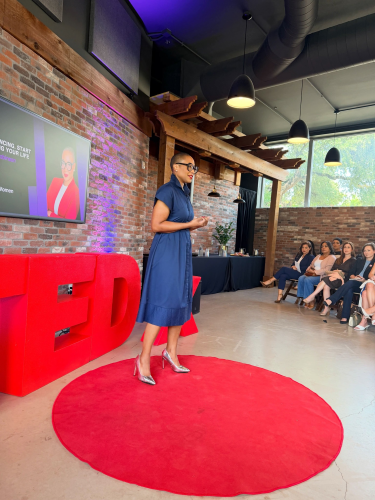
For Dr. Takisha Robinson, clinical research has been that kind of career. She began at the investigative-site level, moved into clinical monitoring, built her experience across Contract Research Organizations, and ultimately stepped into director-level leadership on the sponsor side. Along the way, she completed a Ph.D., became a parent, took the TEDx stage at Round Rock Women, and found her way into the classroom where she now teaches Clinical Trials Project Management.
Read more about her journey, her TEDx talk, and what she believes the field actually needs from the next generation of clinical research professionals.
What led you to a career in clinical trials, and eventually into teaching?
My path into clinical research was not something I had completely mapped out from the beginning. My academic background was in public health and biology, and I knew I wanted a career that brought together healthcare, science, business, and people. Clinical research became that place for me.
I started my career closer to the investigative-site level, where I was able to see firsthand what it takes to conduct clinical trials and support patients participating in studies. From there, my career progressed into clinical monitoring, where I worked directly with research sites as a Clinical Research Associate. That experience gave me a much broader understanding of how studies are conducted across multiple sites and what is required to maintain quality, compliance, and strong site relationships.
I then moved into study and clinical operations management within Contract Research Organizations (CROs), taking on increasing responsibility for study teams, sites, timelines, and overall trial execution. Those experiences ultimately prepared me to move into director-level clinical research and development leadership roles, where my responsibilities expanded beyond managing individual studies to building programs, leading cross-functional teams, developing operational strategy, and helping translate clinical evidence into meaningful outcomes for patients and organizations.
Today, I continue to work on the sponsor side of clinical research, leading clinical trial activities and applying lessons from each stage of that journey.
That progression is also one of the reasons teaching is so meaningful to me. I can remember being early in my career and trying to understand not only how clinical trials worked, but also where a career in clinical research could lead. I want students to see that this is a field where you can continue to grow.
Teaching gives me an opportunity to take what I have learned across sites, Contract Research Organizations, sponsors, and leadership roles and make it practical for someone who may be taking their first step into the industry or preparing for their next one.
Congratulations on your TEDx Round Rock Women talk. Can you share what the topic was and what inspired you to pursue this opportunity?
Thank you! My talk was titled “Stop Balancing. Start Integrating Your Life.” The idea really grew out of my own life. Like many people, I spent years hearing that the goal was to achieve “work-life balance.” But as my career grew and I took on different roles as a professional, educator, doctoral student, wife, mother, and community leader, I began to realize that perfect balance was not only difficult to achieve; it was not necessarily what I needed.
There are seasons when one part of life simply needs more of you. I learned to focus less on making everything equal and more on intentionally integrating the things that matter most.
TEDx gave me an opportunity to share that lesson with others, but it also challenged me personally. I spend a great deal of time encouraging other people to grow, so I thought it was important to continue putting myself in spaces that required me to grow too.
What do you hope audiences took away from your talk, and why does that message feel important to you personally and/or professionally?
I hope people walked away giving themselves permission to stop chasing an unrealistic version of balance.
Integration does not mean doing everything at once. It means knowing what matters to you, understanding the season you are in, and being intentional about where your attention needs to go.
That became very real for me while navigating a demanding career, completing my Ph.D., teaching, serving in my community, and being present for my family. I learned that I did not have to give everything the same amount of attention every day to still be committed to all of it.
I think that applies to our careers as well. Careers are rarely perfectly linear. There are seasons when we are leading, seasons when we are learning, and seasons when we may need to make room for something else. None of those seasons diminish the others.
How has the experience of giving a TEDx talk influenced the way you approach teaching clinical research concepts to your students?
The TEDx experience reinforced something I already believed about teaching: people remember what they can connect to.
Preparing for TEDx required me to take a big idea and make it clear, relatable, and useful. I try to do the same thing in the classroom.
Clinical research has its own language, regulations, processes, and acronyms, and that can initially feel overwhelming. I do not want students to simply memorize terminology. I want them to understand why something matters and be able to recognize what it looks like when they encounter it in the real world.
What courses do you teach, and what can a prospective learner expect from your class?
I teach Clinical Trials Project Management. What I want prospective learners to know is that this is not a course where you memorize terminology or project management methodologies. One of the things I really wanted when designing the course was for learners to experience clinical trial project management as something they do, not just something they read about.
Throughout the course, we take concepts and put them into practice. For example, learners may review a clinical trial plan and identify operational risks, build a project charter and work breakdown structure, examine a Gantt chart to identify dependencies and the critical path, or develop a RACI matrix to determine who is responsible and accountable when multiple functions are working toward the same milestone.
We also explore how real-world data can inform study feasibility and diverse patient population considerations, and students work through realistic study challenges involving areas such as site activation, enrollment, timelines, risk mitigation, database lock, and inspection readiness.
What makes the course especially engaging is that we don't stop at “What is the project management tool?” We ask, “How would you actually use it to make a decision?”
That is where I bring my own clinical operations experience into the conversation. I want learners to understand how Clinical Operations, Regulatory Affairs, Data Management, Biostatistics, clinical research associates, sites, and other functions have to work together to move a study forward, and what happens when the plan changes, because it will.
My goal is for learners to finish the course with practical tools they can recognize and apply in a clinical research environment, but also with greater confidence in how they think like a clinical trial project manager: anticipating risk, asking the right questions, communicating across teams, and keeping the larger study objective in view.
Whether someone is trying to enter clinical research or is already in the industry and preparing for greater responsibility, I want them to leave the course thinking, “I understand how all of these pieces connect, and I can see myself doing this work.”
How do you bring your real-world experience into the classroom to keep the material relevant and engaging?
This is one of my favorite parts of teaching because I have had the opportunity to experience clinical research from several different perspectives.
I began closer to the investigative-site level, progressed into clinical monitoring, moved into study and clinical operations management within Contract Research Organizations, and ultimately advanced into director-level leadership roles on the sponsor side. Each step gave me a different view of the same clinical trial ecosystem.
That means when we discuss a topic in class, I can help students look at it through multiple lenses. What does this mean for the research site? What is the monitor responsible for? What is the study manager considering? What does the sponsor need to know? And, as you move into leadership, how does that same issue affect the broader study strategy, timeline, budget, risk, or organization?
I often tell students, “Here is what the process says should happen, and now let's talk about what this can actually look like when you're running a study.”
Clinical trials rarely operate under perfect conditions. Timelines change. Protocols are amended. Sites encounter challenges. Teams have competing priorities. Learning the regulations and processes is important, but so is learning how to communicate, problem-solve, assess risk, and make thoughtful decisions.
That is the perspective I try to bring into the classroom. I want students to learn the technical foundation, but I also want them to begin developing the judgment they will need as they grow in their own careers.
What do you find most rewarding about teaching in this field, and what excites you about the future of this field?
The most rewarding part is watching someone begin to see a place for themselves in clinical research.
Some learners are already working in healthcare or research and want to grow their careers. Others are exploring the field for the first time. I love the moment when something clicks, and a student realizes, “I could actually do this.”
I am also excited about where clinical research is going. Digital health, medical devices, real-world evidence, decentralized approaches, artificial intelligence, and new ways of engaging patients are changing how we generate evidence.
Technology will continue to evolve, but we will still need people who understand how to conduct research responsibly, protect participants, collaborate across functions, and turn scientific ideas into studies that can actually be executed. That human element remains incredibly important.
What would you say to someone who is considering enrolling but is unsure whether it's the right step for them?
I would tell them: You do not have to have your entire career figured out before you take the next step.
If you are curious about clinical research, give yourself permission to explore it. Taking a course can help you learn the language of the field, understand how the industry works, and begin identifying where your existing skills might fit.
There is no single path into clinical research. We need people with backgrounds in science, healthcare, operations, project management, technology, data, regulatory affairs, and many other disciplines.
Come ready to learn and ask questions. You may discover that you already bring more transferable experience to the field than you realized.
Anything else you'd like to share?
One thing both my professional journey and my TEDx experience have taught me is that growth does not always happen according to a perfect plan.
There are opportunities in my life today that I could not have predicted when I began my career. Each role, challenge, classroom, and season contributed something to what came next.
That is something I hope my students carry with them beyond the course. Learn the technical skills but also stay curious. Build relationships. Be willing to stretch yourself. And do not underestimate the value of the experiences you already bring with you.
At the end of the day, clinical research is about people. Whether we are designing a study, partnering with an investigative site, generating evidence, or preparing the next generation of research professionals, remembering the people behind the process is what gives the work meaning.
Interested in building a career in clinical research?
According to the U.S. Bureau of Labor Statistics (BLS), healthcare occupations are expected to experience strong employment growth between 2025 and 2035, exceeding the average rate across all industries.1 The Clinical Trials Project Management course is one class that can help you build the skills needed to pursue opportunities in this growing field. Learn more about the Clinical Trials: Medical Device and Drug Development Certificate Program Information. DCE also offers a certificate program in Clinical Research.
1 U.S. Bureau of Labor Statistics, Occupational Outlook Handbook: Healthcare Occupations, U.S. Department of Labor. https://www.bls.gov/ooh/healthcare/ ↩